Reginald Sylvester II
Art Genève 2026
29 January–1 February, 2026
Booth D39
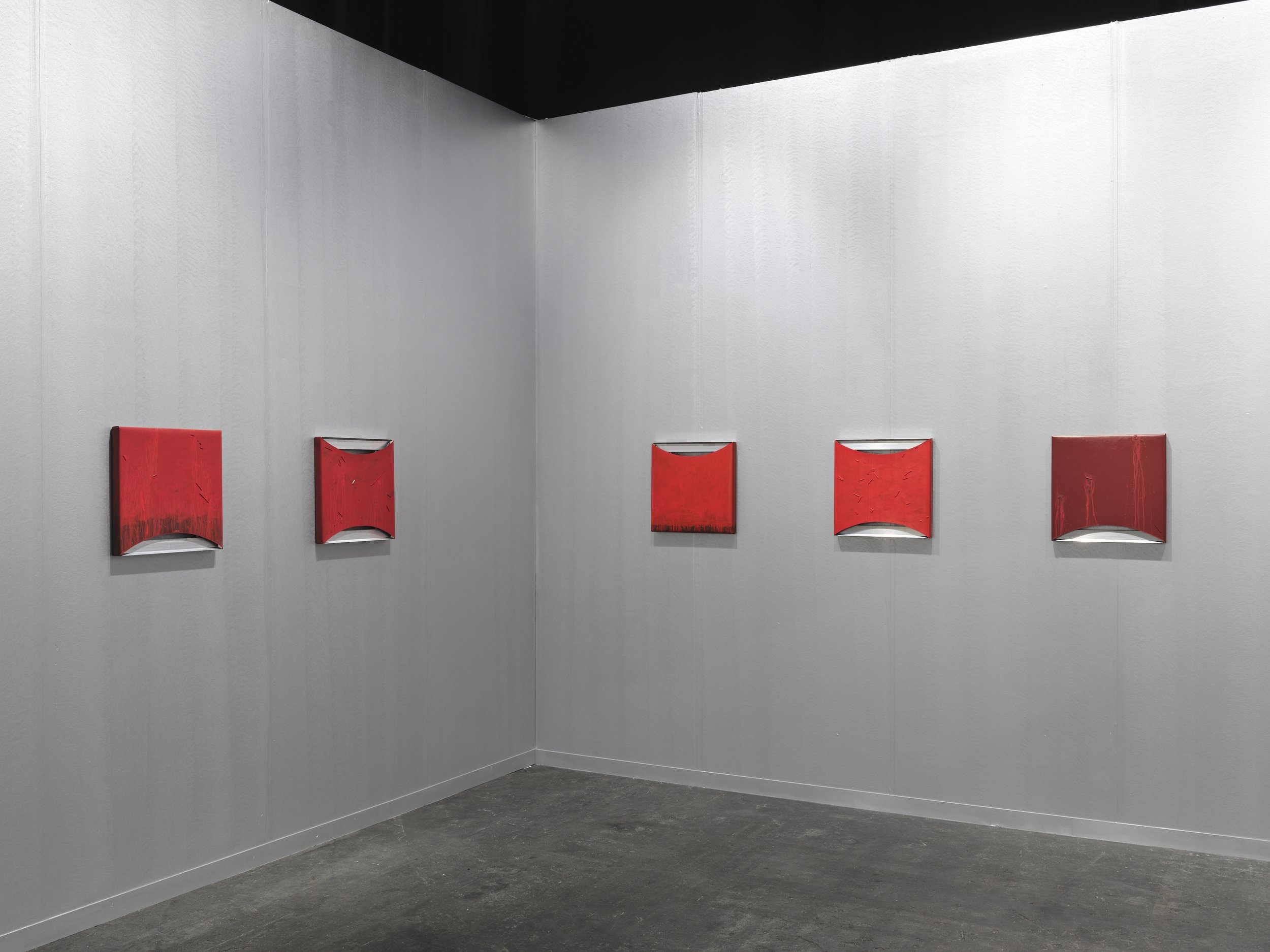
Maximillian William is pleased to announce its debut presentation at Art Genève with a solo booth of new paintings by Reginald Sylvester II. The presentation comprises a suite of nine works from the artist’s ongoing Offering series.
Started in 2022, the series marked a shift in Sylvester’s practice, reorienting his abstraction toward materially restrained, contemplative compositions conceived as acts of offering. Central to this body of work is Sylvester’s use of industrial rubber, a material bound to histories of colonial extraction. Through processes of cutting, stretching and accumulation, rubber is reconfigured into near-monochromatic surfaces that hold a dense materiality and offer a powerful emotional register. Moving away from traditional canvas, the Offering series foregrounds charged materials and bodily processes, informed by passages in the Bible, Abstract Expressionism and Art Povera. This presentation follows his recent solo institutional exhibition at Limbo Museum in Accra, Ghana.
Further information, fair opening times and tickets
–
Reginald Sylvester II (b. Jacksonville, NC, USA, 1987; lives and works in Jersey City, NJ) creates large-scale paintings and sculptures that trace the generative threshold between the two mediums. Working predominantly in abstraction, he expands the language of his painting practice by incorporating materials such as rubber, tarp, aluminium and steel. His singular approach lends his paintings a sculptural presence and imbues his sculptures with a painter’s sensibility.
While grounded in traditional painting techniques, Sylvester II ventures beyond the conventions of stretched canvas, working on surfaces that both absorb and reject paint. His layered, often multi-partite works investigate the language of his chosen mediums: stretcher bars are left exposed, becoming part of his compositions, while oxidised and patinated metal surfaces evoke the histories of gestural painting. Sylvester II also transcends the surface, creating monumental sculptures that reference forms observed through painting and from his environment.
The artist is drawn to materials that relate to his personal history, spirituality, or broader societal narratives. In his approach to assemblage, Sylvester II appropriates byproducts of his making process, physically attaching studio debris to works to enrich their tactile quality and textural narrative.